
When I left Google to work on Accretional, I'd done very little web development—mostly infrastructure and systems work for cloud platforms. Accretional's goal is to build a platform that handles everything between having an idea and having a shipped product: the website, hosting, dev environment, auth, payments, email—all designed together. The premise is simple: most work developers do isn't the valuable part. The valuable part is the core business logic. Everything else is glue, and the glue takes all the time.
I'd spent my career living that struggle, and seen it from the other side at Google Cloud: too many rough edges, too much fiddling with integrations, too little useful documentation, too much goddamn complexity getting in the way of work that matters.
The SVB Website That Never Was
During the SVB collapse, I tried to make doihavesvbexposure.com—just a simple site to help during that week everyone was freaking out. I registered a domain on Namecheap, then hit the confusing part: so many ways to deploy, so many products and frameworks, so many unknown-unknowns.
I Googled "easiest way to host a website free site:reddit.com" (as any sensible person would). Most people recommended a static site generator. Jekyll seemed popular and had a cool name, so I tried it.
Ugh. Jekyll makes you install Ruby, learn Gemfiles and bundles, then walk through nine articles about Liquid, Layouts, and Collections before you have anything beyond "Hello World." After finishing page one of setup, I saw eight more pages ahead. I said "fuck this" and gave up. The SVB panic was cooling off anyway.
Learning the Hard Way
A year later, it bothered me how little I knew about the web despite working in cloud. I made a simple webgame in vanilla JS and HTML, deployed it from an S3 bucket cached by Cloudflare. Finally, a site! But I was shocked at the pieces involved:
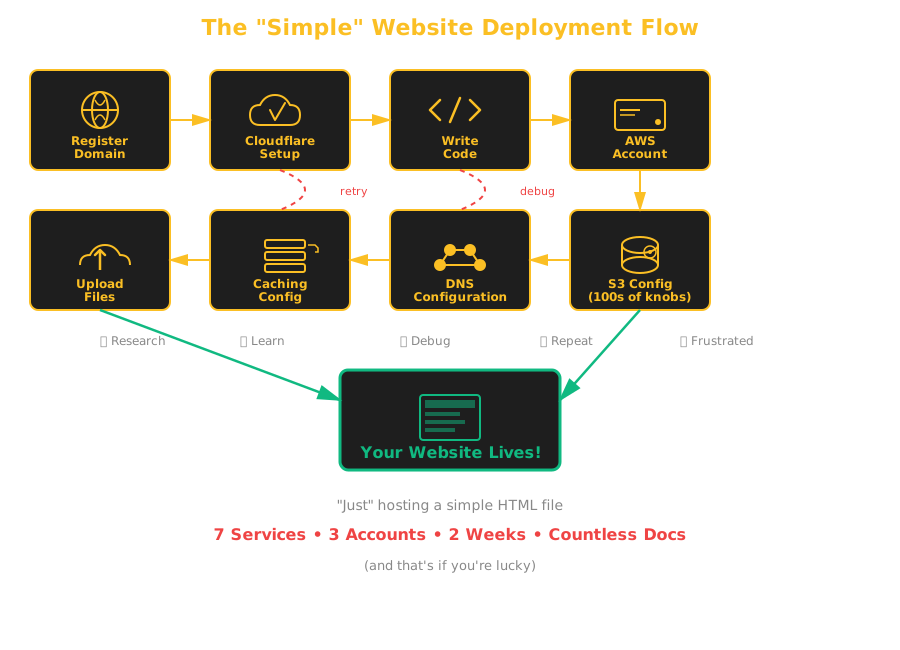
Register a domain (make an account, add billing, figure out upsells vs must-haves). Onboard to Cloudflare (another account, learn DNS and nameservers, understand proxying and certs). Write the game (learn HTML, JS, CSS, browser APIs, dev console). Upload to S3 (AWS account, navigate IAM, understand regions, configure hundreds of knobs). Make the bucket public (in the specific way for websites and Cloudflare caching). Point DNS (learn A/CNAME records, CNAME flattening, TXT verifications). Configure caching (so updates actually show in my browser—they didn't at first).
How could such a common problem—"I want to host some basic HTML"—be so complicated when everyone starts the same way? The only alternatives were fragmented DIY or expensive template tools like Squarespace that aren't built for how developers actually work.
Building What We Needed
When Accretional got serious, we needed a real website. We were building our product in Svelte and wanted to use the same components for our marketing site. But static site generators assumed you'd use their templating (Hugo, Jekyll) or buy into React (Gatsby, Next.js). SvelteKit can generate static sites, but it's a full framework—complex config, and you still handle hosting, DNS, and certs separately.
Even if site generation was solved, everything else stayed fragmented. Pick a generator, separately handle hosting, separately configure DNS, separately deal with certs and caching. Or use Framer, which bundles it but costs a fortune and locks you into templates.
I was told there would be hypertext—why do I need all this bullshit just to serve hypertext?
Then I realized: if we're a developer tools company and can't find a tool we need, maybe we should build it. How hard could it be to generate webpages from Markdown without configuring six different services?
Actually, not hard.
What We Built
We built Statue. It's two things:
An open-source npm package. Create a site, write Markdown, generate static files with one command. No Ruby, no Liquid, no config maze. Built on SvelteKit—use the same components and patterns you already know. Don't know Svelte? Use Brilliant, our browser-based IDE, to modify your site by describing what you want. It runs your dev environment in the cloud, renders in your browser, lets you preview changes and deploy without touching a terminal. MIT-licensed—do whatever you want.
A managed hosting service. Domain registration, DNS, SSL, CDN—handled. Pick a domain, your site is live. Hosting is free, domains at cost. Push changes, they deploy automatically.
Use either piece independently. Deploy Statue's output to Vercel, Netlify, Cloudflare Pages, your own server—they're standard static files. Use our hosting for a site built another way. Or use both together and go from "I have an idea" to "my website is live" in minutes, without opening six accounts and reading twelve docs sites.
That's what we wanted. That's what we built.
The Bigger Picture
Statue is the first thing we shipped at Accretional, mostly because we needed it. But it's a natural starting point for everything else we're building.
Your website is the first thing you need—before auth, payments, email, any of it. And it's usually where fragmentation starts: one service for domains, another for hosting, another for deployment. Add authentication, another vendor. Payments, another. Email, another. Each with its own dashboard, docs, and way of doing things. You spend more time wiring them together than building what matters.
We're building the rest of the platform to fix that. Brilliant gives you a dev environment in your browser—no local setup, no "works on my machine." Splendor handles infrastructure: containers, scaling, networking. We're working on auth, payments, email—all the pieces you need, all designed to work together.
The goal is simple: you write the part that matters, we handle everything else. Register a domain, get a site. Add a backend. Accept payments. Send emails. Deploy globally. All from one platform, all integrated, all without the glue work.
That's where we're headed. Statue is where it started.
Try Statue: statue.dev • GitHub • Brilliant